


Yesterday we were joined on Talking Markets for the first time by Blake Morrow, co-founder of Forex Analytix.
QUEUING EVERYTHING OFF OIL
Equities spent most of the session yesterday in the green, buoyed by oil slipping back toward $95 a barrel (imagine writing that sentence a few weeks ago!) “People are thinking there might be an off ramp,” Blake said. “They take President Trump at his word… we’re two weeks into this, he said four weeks or so. We’re starting to see some movement in the Strait of Hormuz.”
Blake’s key level to watch is $95, the September 2023 highs. Above it, markets are edgy. Below it, there’s at least a measure of calm. “You get below that, I think markets are at least more at ease, if you will.”
Note… as of Tuesday morning, oil prices inched up again, with WTI around $96 and Brent futures around $103. So we could be in for a red day in markets.
CURRENCY MARKET VOLATILITY
Implied volatility on currency pairs like EUR/USD has spiked from a normal 5-6% range to around 10-11%. “A lot of fund managers probably had some pretty rough weeks the last couple of weeks,” Blake said. “I’ve read so many numerous accounts on how big fund managers are really struggling because of the whipsaw action.”
The current risk-off environment is also behaving differently from what traders have seen before. In a typical flight-to-safety, you’d expect carry-trade unwinds: higher-yielding currencies like the Australian dollar, Kiwi, and Canadian dollar getting sold as capital repatriates. But because the Strait of Hormuz disruption is hitting European natural gas and Japanese energy imports hard, the usual playbook is distorted.
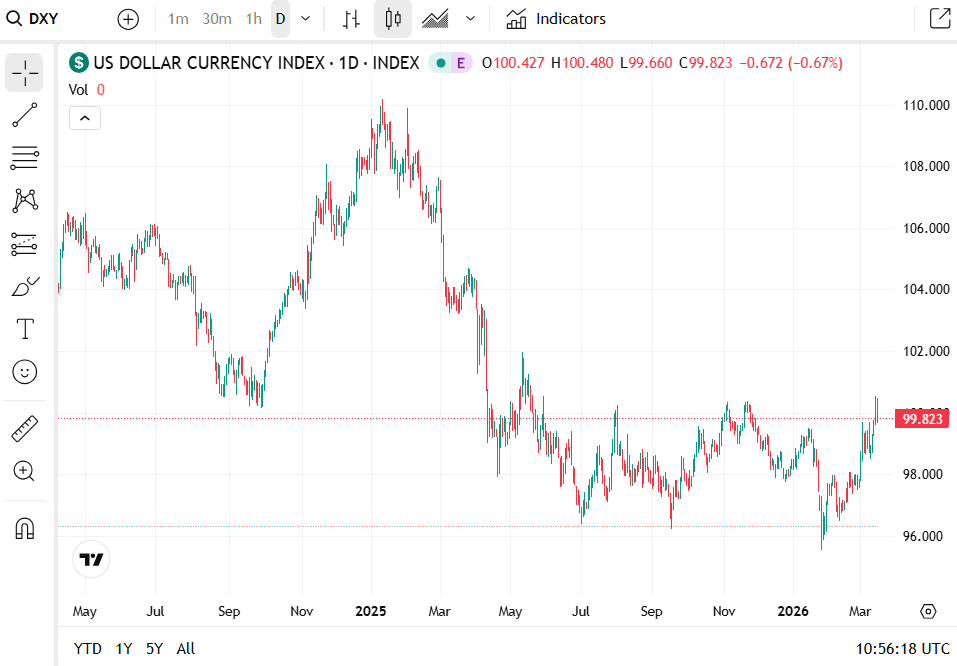
The DXY is the number Blake wants everyone to have on their radar: “We’re flirting with 100. If it gets much above 100.50, that’s the level that everybody should be looking at. We get above that, that means that the market’s uneasy about what’s happening.”
CENTRAL BANK WEEK
It’s a busy week for central bank meetings - we’ve got the Fed, the ECB, the BOE, the SNB, the BOJ, and the RBA.
Blake noted that not every central bank is operating with a dual mandate. Many, the ECB included, are primarily focused on inflation. “I think it’s crazy — I don’t think the ECB is anywhere near raising rates, even though the market’s starting to price it.”
President Trump was pushing again yesterday for an emergency rate cut, citing surging fuel prices. There’s also the Powell question hanging over the week. His tenure as chair is approaching its end, and the well-documented tensions between him and the administration mean his press conference tone will be parsed extremely carefully. “How he responds is going to be really critical to what the dollar does,” Blake said. “That’s why I think the Fed meeting is actually going to be kind of an interesting one.”
BONDS AND INFLATION
When the US attacked Iran, the 10-year and 30-year Treasuries gapped higher, then gave it all back. “Wars are inflationary,” Blake said. “If you look at the Trump administration, they’ve been pretty vocal about how much payload they’re dropping in Iran. It doesn’t take a rocket scientist to calculate THAT we’re spending a lot of money. So you’re seeing yields rip.”
It’s a worldwide phenomenon, not just the US. And while yields settled somewhat yesterday, the structural pressure remains.
“I feel like we are stepping closer to yield curve control in one way, shape or form sooner rather than later, if this doesn’t stop,” Blake said.
PRIVATE CREDIT, CONTD.
The private credit story rumbles on, even with most attention directed to the Iran war.
A couple of days ago Apollo executive John Zito told UBS clients that private equity firms are broadly misstating the value of their software holdings.
“Once you start the finger pointing, that’s when everybody’s like, well, I’m not going to pay you 40 cents on the dollar, I’m going to pay you 20 cents on the dollar,” Blake said.
The system has held together largely because nobody wanted to mark to market. Extend and pretend, basically. “It’s not like they can hit the bid,” Blake said. “It’s worse than real estate. When you’ve got paper and you’re trying to sell it to somebody, it’s not like you just turn around and hit the bid like we do in most developed markets.”
BLAKE ON…
MISINFORMATION
“It’s so important to follow a really reputable news source right now. [Blake uses LiveSquawk] We see things in different timelines. We’re not sure if that’s actually breaking news. Being able to see news in real time as it’s coming is super important, because there’s a lot of misinformation out there.”
JAPAN
The yen isn’t behaving like a traditional safe-haven this time around because Japan, a major energy importer, is acutely exposed to the Strait of Hormuz disruption. Speculators know it. Dollar/yen is nearing 160, an intervention-territory level. “If I was the Ministry of Finance, I would step in when the speculators really start taking it above 160 because that’s when you can crush a lot of the spec market,” Blake said.
GOLD
Gold has been consolidating after a rip-roaring rally. “We drop below $4,900, we’re going to be trading down to $4,500,” Blake said. “If given the opportunity to buy gold again in the mid-$4,000s, I’m going to take it this time, because I didn’t the last time.”
Thank you Lucas Derraugh, Daliah Savino, Leslie Storch, and many others for tuning in live! We’ll be back Talking Markets on Fed Day (Wednesday) with Peter Boockvar.
Important Disclaimer: It is crucial to remember that this article is for informational purposes only and should not be considered investment advice. Consult with a qualified financial advisor to assess your risk tolerance, investment goals, and overall financial plan.


